Leaders are readers. Upgrade your library here!

Click the link to get some of my best recommendations for your library!

From Idea to Ignition!

YOU'VE ASKED FOR IT AND NOW IT'S HERE!!! DON'T MISS THIS CHANCE TO PROPEL YOUR BUSINESS AND LIFE FORWARD!

Masterminds and Expert Coaching

All the best performers in any field have a coach. Shouldn't you? Mastermind Groups and one-on-one coaching are both available for those interested in partnership and accountability in working on their vision and goals.

Visit the Live BIG! Die Empty. Store!

Check out these great resources from the mind of Mark Anthony McCray...with more in development every single day!

Invite Mark to share at your next live event, workshop or seminar!

Each keynote or workshop session can be customized with relevant examples, anecdotes and solutions to match your audience and your needs. Just ask! If you want Mark to come and speak at your meeting or conference, just e-mail!

Blogroll

Showing posts with label entrepreneurship. Show all posts

1/26/14

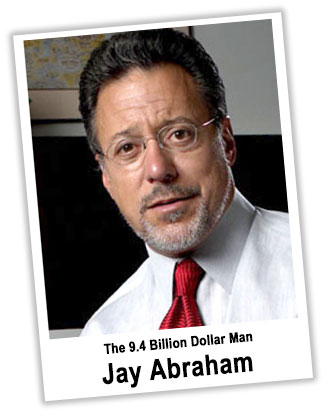
There's a lot entrepreneurs can learn from @RealJayAbraham


... at the very least he's a genius.
If you feel like you need some breakthrough insights for your business, I urge you to listen to Anthony Robbins interview Jay Abraham here and here for Part One and Part Two.  It's something special.  By the end, you'll be looking for Parts Three, Four, Five and more!

A lot stands out and I won't try to re-preach Jay's sermon, but here is something that stands out from his hour plus on "How to Exponentially Increase Your Business."  For starters, if someone asked you "How many ways are there to increase your business?" you might list a dozen approaches.  In reality, there are only three ways to increase the revenue side of your business - any business:

  1. Increase your number of clients and/or prospects.  (duuuuhhhh) To do this you must employ more than one way of bringing in clients, e.g., sales teams, outbound sales, inbound sales, direct mail, etc.  Most companies only acquire clients through one avenue but looking at other companies (even in other industries)  can show you some ways to raise the number of prospects.  Risk-reversal is the secret.  You've got to lower the customer's risk of doing business with you.
  2. Increase your unit of sale.  This can be done by increasing your prices, pressing more add-ons and up sells or increasing the size of your product bundle so people pay more and also get more value.  While you're working to increase your customer base, also work to increase how much each customer spends with you. 
  3. Increase the residual value of each client and/or their frequency of purchase.  More referrals.  More back-end sales.  Sales of warranties.  This can be done by reducing attrition, too, by the way.  The idea here is to deepen the relationship with your customers and involve them in capturing more business for you.
Do any one of the three and you will grow your business geometrically - imagine being just 10% more effective in each area.  If you can do all three of these at the same time even a little bit and your business grows exponentially (10% + 10% + 10% is typically more than a 30% revenue increase) and keeps growing!  And that's your goal!

Go back and listen to Jay's insights.  I guarantee you'll get something you can put to work for you.

Are you looking for more guidance on building and expanding your business?  Get your copy of "From Idea to Ignition: How to Get Your Business off the Ground" today and also check out "The Sales Monster - 10 Ultimate No B.S. #MonsterTips to Help You Sell More and Earn More Money NOW!"  Both are packed full of information and insights you can take to the bank!  Available for download right to your Inbox after purchase with tons of bonus material!


Mark Anthony McCray helps people live on PURPOSE, achieve higher PERFORMANCE and experience true PROSPERITY.  Be sure to subscribe to this blog so you don't miss a thing and forward this to a friend if you found it helpful. All material © Copyright, Mark Anthony McCray unless otherwise noted!


He can be reached in the following ways:
Mark@LiveBIGDieEmpty.com
Phone: 281-846-5720
Twitter: @LiveBIGDieEmpty
Facebook: http://www.facebook.com/LiveBIGDieEmpty
LinkedIn: http://www.linkedin.com/in/markanthonymccray/
Google+: https://plus.google.com/u/0/103149858138414160703/posts
YouTube: http://www.youtube.com/user/markanthonymccray

For more information on Mark as a speaker or presenter check out http://www.gigsalad.com/mark_anthony_mccray_houston


10/27/11

Marketing for BIG Impact with small Dollars


I've been keeping a small file of marketing ideas especially for entrepreneurs and small business owners for years. Many I've used myself and some I've either seen other business owners use. All are effective and all require you to actually DO SOMETHING!! But they don't necessarily cost a lot of money. You might be surprised at how much impact you can generate for a few bucks.

Before we get going, you might want to read some of my previous blogs on marketing so you know where I'm coming from. One is called "The Ten Commandments of Marketing Yourself, Your Product or Your Services" and it will give you a baseline understanding of my philosophies regarding marketing.

Another that you'll want to check out is called "The Nine Most Powerful Words You Can Utter" and I've also written an article about using social media effectively called "Mark's 10 Be's of Social Media" and I'd love your feedback on any of them! I think there's helpful information for you. My heart goes out to the entrepreneur. Believe me. I understand the challenges of generating business from scratch!

Here's a list of some cheap, cheap tactics you can use now!

1. If you are targeting local businesses or offices, go to a cookie place and buy one of those HUGE cookies. Have them paint your name and number on the cookie using icing. Deliver it in person. Everyone will be talking about you for days! It's important NOT TO USE SMALL COOKIES. You want to use a big cookie because they are too big for one person to eat alone...forcing at least a few conversations about you and your company!

2. Hold a contest. A simple contest or questionnaire will work even without a prize...or much of a prize. For example, email or use social media to ask people what you should call your company. Tell them your top three choices for names or logos. Ask for their feedback. People are always glad to share their opinions and, in the process, you will have an opportunity to tell them all about your practice. It works!

3. It's an overlooked tactic because it takes a little work, but make some cheap flyers and pass them out door-to-door. If you want to turn it up a notch, approach other companies and offer to deliver their flyers for them! If you can get just a few to say "yes" it will pay for your own flyers right away. Want to turn it up another notch? Get some neighborhood kids to hang them on doors for you. Just don't litter! I don't want any calls from jail. I've done this one before. It works really well if you need to move some feet to your business location.

4. Hire an artist (Craigslist will do just fine.) to use chalk to draw your company name and logo on a busy street downtown with directions to your shop or to your website. People will think it's neat. They will remember. Take a bunch of pictures for your social media site. Tweet it. Fun is memorable! It's cheap, too. You can always find a local college student who will be willing to the job for you.

5. I like to call T-Shirts walking billboards because they are cheap and always tell a story. Give some away. Make it a big deal or some kind of contest. You only need a dozen or two and that few can be had for not much at all. People like free things. Plus they have what I call "trophy value" if you do a contest. People will be glad to tell others how they won it every time. It's a win for you. Just be sure to include your website in the design.

Got any ideas you want to add? Please email mark@livebigdieempty.com and I can include them in a future blog or update! The bottom line is you can't be afraid to do something different. Getting people to talk about you is part of the point! Marketing Outrageously by Jon Spoelstra is an excellent and fun read to help you break out of the normal ways of thinking about marketing.


Of course, I have to make one more mention. I wrote an EBook called "10 Ultimate No B.S. #MonsterTips to Help You Sell More and Earn More Money NOW!" and it's important because you have to know how to close the business once people start calling you. Please purchase a copy if you need more business!


Mark Anthony McCray helps people live on PURPOSE, achieve higher PERFORMANCE and experience true PROSPERITY.  Be sure to subscribe to this blog so you don't miss a thing and forward this to a friend if you found it helpful. All material © Copyright, Mark Anthony McCray unless otherwise noted!

He can be reached in the following ways:
Mark@LiveBIGDieEmpty.com
Phone: 281-846-5720
Twitter: @LiveBIGDieEmpty
Facebook: http://www.facebook.com/LiveBIGDieEmpty
LinkedIn: http://www.linkedin.com/in/markanthonymccray/
Google+: https://plus.google.com/u/0/103149858138414160703/posts
YouTube: http://www.youtube.com/user/markanthonymccray

For more information on Mark as a speaker or presenter check out http://www.gigsalad.com/mark_anthony_mccray_houston


10/14/11

"The 12 Elements of a Winning Business Idea"


So...how do you know a good business idea when you see it? It's really all about studying the business model. Most successful businesses have more in common than they have different and knowing the commonalities can save you a lot of headaches and make you a lot of money. Therefore, whether it's waste disposal or concrete mixing or baking, focus on building your business based on a proven model - it's structure - and you'll increase your chances of success.

Side Note: I post a number of tips on the Live BIG! Die Empty. Facebook page. Click the link to follow that page!

A business model is the way that costs and potential revenues interact. Put another way, a model is the structure that a particular business will use to get raw materials, add value, and sell the finished product to the market. Therefore, there are three main components to a business model:

(1) The markets and customers
(2) The services and products to be offered
(3) The distribution method

There are five rules of good business models according to Seth Godin, author of The Bootstrapper’s Bible: How to Start and Build a Business with a Great Idea and (almost) No Money (along with many, many other thought-leading books). According to Godin, one of the best business and marketing minds of the last couple of decades, a good model should be as follows:

1. Profitable – You should be certain that the revenues from sales exceed the costs of obtaining raw materials (supplies and labor) and adding your value by developing the finished product.

2. Protectible – It should be relatively difficult for a competitor to enter your market. You should at least be able to see competitors coming so that you can account for them.

3. Self-priming – Not only should your model be profitable, but each sale should generate enough profit to allow you to develop a new finished product and retain some earnings.

4. Adjustable – What happens when your competitors prove to be more formidable than you once thought? You have got to be able to change the way you do business to survive.

5. Exitable – There should be an exit strategy for your partners, investors, and for yourself. This means that even though your business might revolve around you at the onset, you should be able to build it to a point of being able to function without you.
Once you decide the specific business that you are most interested in pursuing, you should follow these guidelines of business modeling in order to increase your chances of lasting success.

Does a market exist? After all, you will need customers, right? For example, let’s say that you are the world’s foremost expert on asbestos. Asbestos is your life and you think about it all the time. Then, let’s say that you have developed a way to sell asbestos products via the Internet and have representatives local to the customer deliver them. Do you think that you will have an adequate market to allow you to reach your business revenue goals? Probably not. Asbestos sales aren’t exactly peaking right now.

I acknowledge that the example sounds silly. However, I can assure you that many people commit similar errors everyday. You must be fairly certain through observation or study that a market exists for your product. Furthermore, the market must be large enough to maintain your business. Finally, people should find it easy to understand the benefit that they receive from buying your service. People spend money to solve their problems. Are there a lot of people with the problem that you want to solve? Are they willing to pay you what you are asking to do so?

Here are a few more elements of a good business model to consider from my study, research and face-to-face interviews with successful entrepreneurs. I went back through my notes from reading books like "Good to Great" by Jim Collins and Michael Dell's writings about his successes with Dell Computers. I also poured through The Great Game of Business by Jack Stack, Rich Dad, Poor Dad by Robert Kiyosaki and The E-Myth Revisited by Michael Gerber...and dozens more. I also went through my notes from meetings with many of the most successful businessmen I've met over the years.

I blogged on some other books that I like a while back! Here are other things to look for and/or incorporate into your business model:

6. Large potential market that is (hopefully) unorganized and disjointed. One of the things Michael Dell most appreciated about the personal computing market was that many people wanted their own devices, but no one company had stepped forward to dedicate their efforts to solving that one single problem. In fact, people wanted a product so much that they were making their own computers. Dell did the same, as we know, starting off in his dorm room at The University of Texas. Soon he was in demand to make computers for other people and the rest is history. These days, there are a lot of problems out there to be solved. Can you find one begging for a solution?

7. Recurring revenue. Ideally, you want to be involved in a business that incorporates recurring revenue streams as much as possible. When you have that, once you've covered your customer acquisition costs, you'll be in the position to realize profits for the remaining life of that customer. I believe recurring revenues may be the most important element to consider when you're looking at a business idea. If you don't have recurring revenues, you need to be sure to have a way of capturing new customers and servicing them in a very cost-effective manner to be profitable.

8. Breakage. Warranties are a great example of "breakage" in action. It's a simple concept: people pay for services they may not fully consume. Another great example are health club memberships. There are sometimes ethical challenges to incorporating breakage into your business model. Here's the key: you MUST be set up to provide services if and when demanded every single time. In the case of a warranty, if people need service on their appliance, you MUST provide it. It's not an acceptable excuse that you never planned on providing service! On the other hand, if a business is able to sell a warranty, it normally turns into profit instantly. That's why Best Buy pushes them so hard!

9. Reasonably low barriers to entry (skills, capital, legal/regulatory). Whether in terms of the legal and regulatory environment or other factors, for most people it's best to enter a business without barriers set up to hinder them. Infrastructure can be another substantial hindrance. If you want to build a competitive railroad line, you need access to railways. That might be difficult to obtain. It might be easier to provide services within societal infrastructures already existing.

10. Scalable. The best businesses are easy to expand from a small operation to a large or much larger one. "Easy" is a relative term. I understand that. However - and Kiyosaki talks about this a lot - if your business requires rebuilding every time orders increase, you have to reexamine your structure and finds one that scales better. Solopreneurs struggle with this. Let's say you're offering personal chef services? You might be okay with ten clients, but what if you get 100 calls tomorrow? Can you even take 100 calls? It's best to build for scale from the very beginning. I call this "planning to succeed" because you should account for an idea really taking off as well as planning for challenging times.

11. Duplicatable. The best businesses can be duplicated. Once it works, you can take it from market to market to market or set up people to operate your business in other locations. If you're providing a specific product, in what ways can you repeat the process over and over and lowering your production costs? This is where the great Henry Ford changed the American economy. He popularized the assembly line.

12. Leverages current resources. Most entrepreneurs are going to be better off starting where they are and using the skills, resources, capital and people available to them already. Acres of Diamonds, the famous speech turned book by Russell Conwell, talks eloquently about how much most people already have available to us as we're out searching for riches elsewhere or bemoaning their lack. You can download a free copy of Acres of Diamonds here: LINK

Now that you have determined your specific business and you have done some thinking about how you will organize your company, and you are pretty sure that there are customers in the market, you are ready to start planning. If you need a simple, basic business plan to start working through your ideas, use this one: The One-Page Business Plan.

If you have other questions, get in touch with me. Entrepreneurship as a sole source of income or as part of a strategy to build multiple sources of income is going to be increasingly important in the coming months and years...more than it has ever been before!

Side Note: If you're looking for other resources, visit here: LINK

9/16/11

Blogging Live from the Texas Social Media Expo

...I am here at the Texas Social Media Expo about to speak on using social media to establish your personal brand. As a Certified Facebook Addict, the organizer thought I would be a good person to bring in for a panel. He's right!

The speaker before me, John Phillippe (I wonder if he's any relation to Ryan?), is discussing some basics that everyone should cover before diving in. Here are some key points from Z Salvo:

1. Post something somewhere everyday.
2. Decide what pain you are solving for people.
3. Decide why people want to connect with you.
4. Capture the name of everyone who visits you whenever you can.
5. Make it easy for people to do business with you.

Good reminders and he did a great, great job! I would write more but I'm focused on what I need to communicate. He brought me up and helped me shoot some video, so that knocked out some of the nerves!  I will be talking from my "10 Be's of Social Media" blog post.  Should be fun. I need more speaking engagements. 


1/22/11

"One Page Business Planning Guide"


A lot of people have requested this from me over the years, so I thought I would post it to my Blog. It's a simple, but helpful guide to the questions that you should ask yourself as you begin to plan any new business or venture. Appropriately, it's called the "One Page Business Planning Guide" and I hope you put it to good use!

(Friendly Tip: It's not first on the outline, but my experience is that you're going to have a more productive planning session if you start with the "Marketing" Section. This helps you know whether you really, in fact, have a business opportunity or not!)

Mission Statement "What is your goal?"
Briefly describe your team's mission statement. For example, one company’s mission can be described as, "We democratize venture capital." (About 10 words)

Elevator Pitch "What are you doing?"
Briefly explain your team's business concept. Give a summary of your team's vision and how you plan to successfully implement your idea. Imagine you are riding an elevator with a potential investor. Be brief and clear. (About 100 words)

Business Model "How will you make money?"
Summarize how your business will generate revenues and profits. What is your sustainable competitive advantage? Can this business model benefit from scale? Is there an opportunity for subscription-based and/or residual income? Does the business benefit from the “network effect” (customers’ benefits increase as more people become customers)? (About 100 words)

Technology "How does it work?"
Discuss the underlying technology, product development, and/or manufacturing process for your product or service. (About 400 words)

Marketing Plan "How will you get the word out?"
Describe the target audience you plan to reach, as well as the Unique Selling Proposition, pricing strategy, and marketing plan you will employ to market and sell your concept. How will your strategy evolve as you grow? The Positioning Statement is a great way to conclude this step. Use the following outline: For (targeted customers)…who are dissatisfied with (the current market alternatives)…. Our service is a (product category)…. That provides (key problem or pain addressed)…Unlike (product alternatives)…. We have assembled (key whole product features for your specific application)… Geoffrey Moore, Crossing the Chasm, Harper Business, 1999, page 154. (About 400 words)

Distribution Plan "How will you get your product or service to customers?"
Describe your distribution and sales strategy. Will you use a sales force and physical distribution system? For example, will you utilize a direct, 2-step, or more complex distribution channel? Is there an opportunity to bundle your product with another, perhaps more established, product? (About 300 words)

Top Concerns "What could go wrong?"
Explain the top three obstacles that your team's business concept could face in the near future, and how your team plans to overcome such obstacles. (About 300 words)

Competition "Who's in your space and how will you defeat them?"
Explain the competitive advantage of your team's business strategy. Who are your primary competitors and how will they affect your success? What trends prevail in the industry? How will your business affect the market space? (About 400 words)

Financial Plan "How much money do you need?"
Estimate how much capital your team will need to successfully implement your business plan. What investment sources will your team solicit for funding, how will you utilize this capital, and how much money do you plan to make? (About 400 words)


Want more help working through the details of your idea?  Make sure you get a copy of "From Idea to Ignition" today! It's for you if:

You want a simple approach to business planning...
You want a simple approach to developing your launch budget...
You want to understand the twelve winning qualities of a successful launch...

Read more and purchase HERE!


Mark Anthony McCray helps people live on PURPOSE, achieve higher PERFORMANCE and experience true PROSPERITY. Be sure to subscribe to this blog so you don't miss a thing and forward this to a friend if you found it helpful. All material © Copyright, Mark Anthony McCray unless otherwise noted!

He can be reached in the following ways:

Mark@LiveBIGDieEmpty.com
Phone: 281-846-5720
Twitter: @LiveBIGDieEmpty
Facebook: http://www.facebook.com/LiveBIGDieEmpty
LinkedIn: http://www.linkedin.com/in/markanthonymccray/
Google+: https://plus.google.com/u/0/103149858138414160703/posts
YouTube: http://www.youtube.com/user/markanthonymccray
Pinterest: http://pinterest.com/markmccray/

Click HERE for information on Mark as a speaker or presenter and HERE to learn about coaching programs to help you realize your potential and live more prosperously!